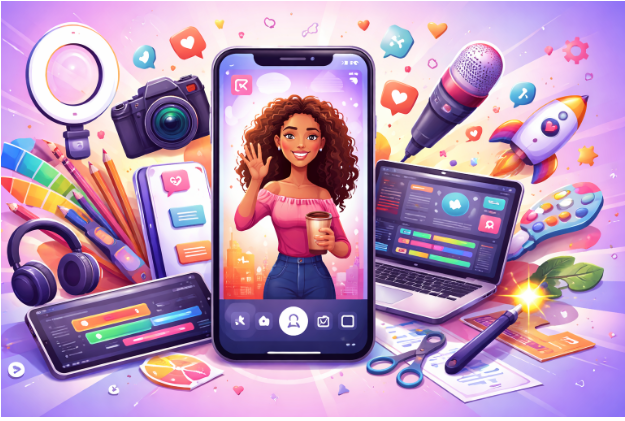

In the rapidly evolving landscape of digital media, the ability to tell a compelling story in sixty seconds or less has become the ultimate competitive advantage. Audiences no longer just consume content; they experience it through a lens of high-speed creativity and emotional resonance. As attention spans shift, a new generation of digital instruments has emerged to help creators bridge the gap between a raw idea and a viral masterpiece. These innovations are not merely making production faster; they are fundamentally redefining the grammar of short-form visual storytelling by democratizing high-end aesthetics and complex narrative structures.
1. Invideo
At the forefront of this revolution is invideo, a platform that has transitioned from a standard editor into a comprehensive powerhouse for automated production. It leverages advanced artificial intelligence to handle the heavy lifting of sourcing footage, generating scripts, and syncing audio, allowing users to focus entirely on the creative direction. Whether you are looking to create reels that capture the latest social trends or produce polished educational snippets, the platform provides a seamless workflow that transforms text prompts into professional-grade assets within minutes.
The true strength of invideo lies in its accessibility across different environments, ensuring that inspiration is never tethered to a desk. By offering a robust ai generated video app, the platform enables creators to generate and refine content directly from their mobile devices without sacrificing the depth of its desktop counterpart. Recent updates have introduced features like “AI Twins” and “Magic Box” conversational editing, which allow users to issue natural language commands to swap scenes or adjust tones instantly. This mobility and intelligence make it an indispensable asset for the modern storyteller who needs to move at the speed of the internet.
2. CapCut
While many tools focus on automation, CapCut remains the gold standard for tactile, trend-driven editing. It has become the heartbeat of social media culture by providing a vast library of viral transitions, auto-captions, and advanced masking tools that were once the exclusive domain of professional studios.
The platform is particularly adept at “rhythm-based storytelling.” Its ability to automatically match cuts to the beat of a music track ensures that even a novice can produce high-energy content that feels professional. With integrated features like 3D zoom and background removal, it empowers creators to experiment with surrealist visuals that pop on small screens.
3. LTX Studio
For those who want to move beyond simple clips and into the realm of “micro-cinema,” LTX Studio offers a groundbreaking approach to frame-by-frame control. Unlike editors that rely on pre-existing stock, this platform uses generative technology to create entire scenes from a script while maintaining strict character consistency.
This is a game-changer for visual storytelling because it allows for a narrative arc—the same hero, the same environment, and the same lighting across multiple shots. It removes the unpredictability often found in generative media, providing a structured environment where a creator can storyboard, direct, and produce a short film without a camera crew.
4. Descript
Visual storytelling is only as strong as its audio, and Descript has revolutionized this relationship by treating video editing like a text document. By transcribing footage instantly, it allows creators to edit their visual narrative by simply deleting words or rearranging sentences in a script.
Beyond simple cuts, its “Overdub” feature can clone a creator’s voice to fix mistakes in narration without re-recording. This “multimodal” approach ensures that the storytelling process remains fluid. For short-form creators, the ability to quickly generate accurate, stylized captions that pulse with the dialogue is essential for retaining viewers in “sound-off” environments.
5. Runway
Runway represents the experimental frontier of visual storytelling. It offers a suite of “magic tools” that allow for high-level manipulation, such as turning a simple sketch into a photorealistic landscape or using “Gen-3 Alpha” to create cinematic b-roll from thin air.
What sets this platform apart is its focus on artistic texture and physics-based motion. Creators use it to add a layer of “dream-like” quality to their shorts, utilizing style transfer to turn standard footage into an oil painting or a futuristic sci-fi scene. It is the go-to choice for creators who want their visual stories to feel like a piece of digital art rather than just another social post.
Conclusion
The barrier between a creative vision and a finished product has never been thinner. Tools like invideo and LTX Studio are not just utilities; they are collaborative partners that expand the boundaries of what a single individual can achieve. By mastering these technologies, creators can shift their focus from the technical frustrations of a timeline to the nuanced art of the narrative itself. As short-form content continues to dominate the global stage, the winners will be those who use these digital instruments to tell stories that are not only seen but felt.